

Venting is healthy. Talking through your frustrations, stressors, and overwhelming feelings with someone you trust is an important part of emotional wellness. It helps you feel heard, validated, and less alone. But there’s a difference between venting that helps you process and heal, and venting that becomes repetitive, unproductive, or overwhelming to others. Learning to recognize that difference empowers you to express yourself in ways that truly support your mental health and your relationships.
Feel overwhelmed and need a safe place to vent? Our mental health specialists can help.
What Does Venting Mean?
We all want to be seen and heard. When we talk to other people about our difficult feelings, that counts as venting. Sometimes, it can be good for us when done in a safe, constructive, and supportive environment.
Some examples of venting include:
- Complaining to your spouse about a coworker missing yet another deadline for a project you’re working on together.
- Telling your coworker about the rude driver who cut you off this morning.
- Calling your best friend about the bad grade you received on your English paper.
- Letting your frustrations out by writing a long, unfiltered post online about your fight with your mom.
In the moment, the main purpose of a venting session isn’t usually to come up with a solution. It’s about being heard and having your feelings validated by someone close to you. Venting serves several purposes:
- To reduce the intensity of your emotions.
- To make sense of your thoughts by putting them into words.
- To confirm that how you feel is appropriate given the situation.
Venting is an emotional release and an outlet for dealing with frustration. It can be healthy, as long as you don’t dwell on these feelings forever.
Why People Feel the Need To Vent
When you speak about your emotions instead of bottling them up, it’s easier to process how you’re feeling and calm down. It may also help lower your cortisol levels.1
Emotional venting also provides you with an opportunity to connect with others. When you connect with someone you trust, it can trigger the release of oxytocin, which also counteracts your body’s stress response.2
Venting also helps us build connections and support within our relationships, whether with colleagues, friends, or partners. Additionally, talking through problems out loud can help us gain perspective, clarify our thoughts, and sometimes discover solutions we hadn’t considered. The need to vent is natural and healthy; it’s how we process stress and navigate difficult emotions.
Does Venting Actually Help?
So, is venting healthy? The answer is, yes, it can be. When venting is done in a safe space with someone you trust, it can be helpful, as long as it’s temporary. Some benefits of venting include:
- Lowering your stress hormones
- Processing (instead of burying) pent-up frustration
- Improving your perspective and developing new solutions
- Moving you from a state of rumination to one of problem-solving
- Building stronger relationships with others while validating your experiences
Sharing your frustrations is a helpful way to take charge of the challenges you come across. A caring, trusted listener may also provide you with insightful advice, guiding you toward a constructive solution.
When Venting Becomes Harmful
Venting can initially feel good. However, venting can also have a harmful effect when it’s not done in a constructive manner.
As Dr. Timothy Harmon, MSW, DSW, a mental health specialist with Clear Behavioral Health, states:
“While venting often feels cathartic in the moment, the available empirical research suggests that unstructured emotional offloading can reinforce distress if not paired with insight or problem-solving.”
Additionally, the matter of who you choose to vent to is also just as important as how you vent. Venting can become harmful through:
Reinforcing Negative Thought Loops
When you’re venting to someone, you need to trust that they won’t share what you’re telling them. You also need to be sure they have your best interests in mind and don’t just commiserate with you. Otherwise, the person you’re venting to can perpetuate a negative cycle by reinforcing your feelings instead of giving you objective support or helping you problem-solve. If they just continuously validate your feelings, it can create a negative thought loop that serves no purpose in solving your underlying problems.
Emotional Dumping
While venting is usually balanced, mutual, and healthy, emotional dumping is not. Emotional dumping is one-sided and feels overwhelming (or even intrusive) to the one being “dumped” on. It also creates an imbalanced dynamic. Over time, this can cause resentment, and the “listener” may begin actively avoiding that person.
Co-Rumination
It’s good to have a trusted friend you can turn to. But in some situations, friendship dynamics can become unhealthy, especially if you’re constantly discussing your personal problems and focusing on the negative without finding a solution. This process is called co-rumination, and it is basically venting that goes too far.
Dr. Harmon explains that:
“Studies on co-rumination have shown that repetitive, emotionally intense discussions, particularly among peers, can increase symptoms of anxiety and depression.” 3
So, instead of feeling better after talking about your feelings, you and your friend remain stuck in the same problems, continuously rehashing the details.
Trauma Dumping vs. Venting
Venting can be a healthy way to share your feelings, but some people cross this line into “trauma dumping.” Trauma dumping is unloading emotional pain onto someone by sharing graphic details of a disturbing event without warning the listener first. This can be counterproductive and even destructive to your personal relationships. Oversharing traumatic content where the listener is not prepared or qualified to help can also trigger secondary trauma for the listener.4
How To Vent
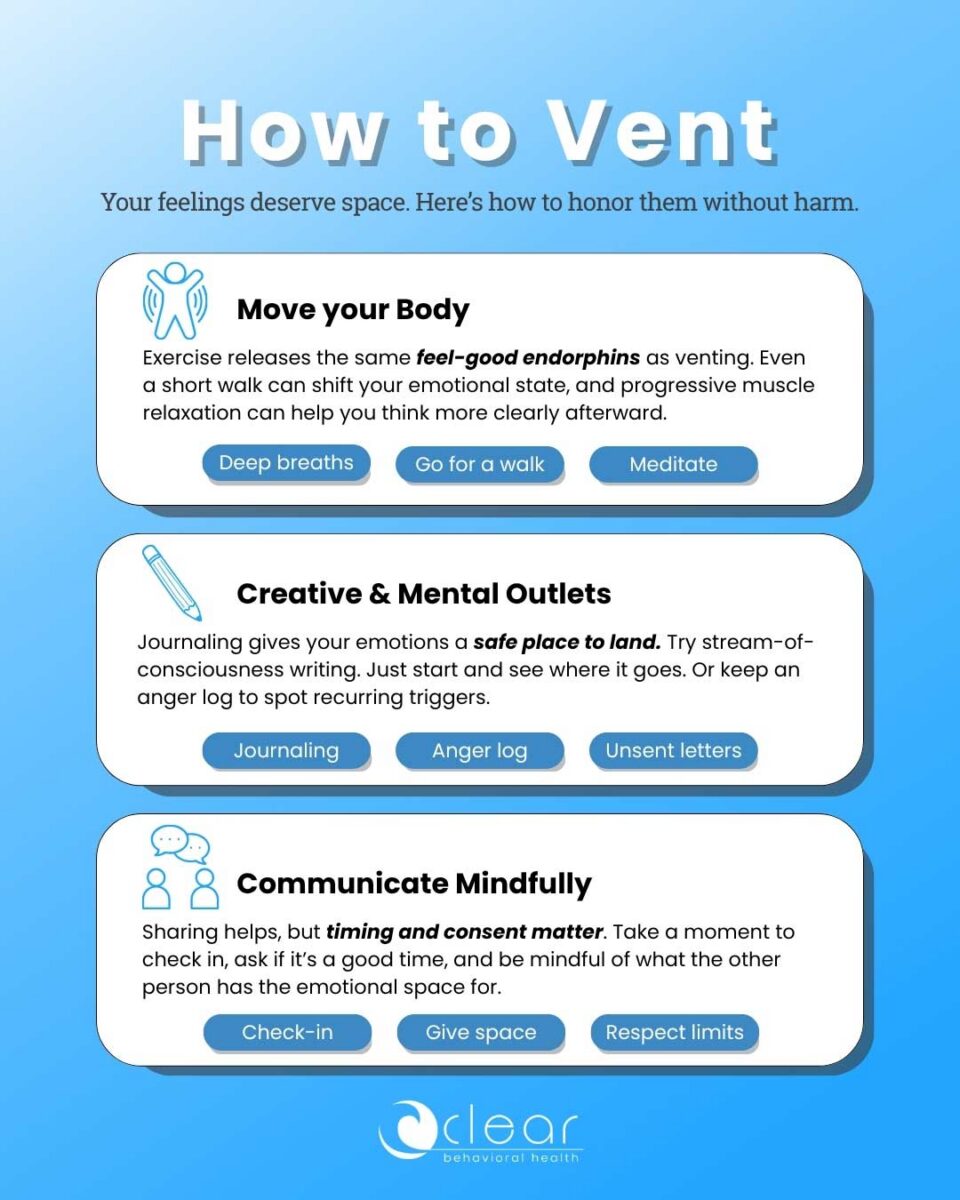
Everyone gets upset from time to time. Sometimes, the circumstances are beyond your control. But you can control how you react to a situation. The ways you choose to vent can both honor your feelings without causing harm to your well-being or your relationships.
Physical Ways To Release Frustration
Sometimes, working through frustration through physical release is an effective way to vent. Working out or going for a run can help release similar endorphins to those from venting.5 Progressive muscle relaxation can also help you shift into a calmer state, which lets you think through things more rationally.6
Related: The Mind-Body Connection: How Caring for Your Mind Impacts Your Physical Health
Creative and Mental Outlets To Try
Journaling allows you to express your emotions, and it works well as a venting tool, too.7 Journaling can also help you explore possible solutions to your problems and provide you with a healthy emotional release. Consider using “stream-of-consciousness” writing to dump your thoughts onto paper. Just start writing and see where your thoughts take you. Another way to journal is to create an “anger log” to help you identify if there are any recurring triggers for your emotions.
Constructive Communication Strategies
Remember, venting can be a healthy way of coping with difficult situations. But it can be helpful to take a moment to think about a few things first. Before sharing your worries, ask how the other person is doing and if it’s a good time to talk. If the subject matter is potentially triggering to them, let them know first. This allows them to opt out if they’re uncomfortable with the topic.
Remember to respect their boundaries. Even after getting their consent, use your own judgment. Consider whether you should vent to them or if someone else might be better suited to listen. If you’re given a green light to vent away, it’s still a good idea to give yourself a time limit of ten minutes (or less).
Why Therapy Can Be a Healthier Place To Process Emotions
If your venting sessions are counterproductive or they’re starting to affect your friendships, that’s when it’s time to seek out more helpful alternatives.
Therapy can be a great opportunity for you to have a dedicated space to discuss your problems and work towards personal growth. Therapists are trained to be completely present and in the moment without any expectations or judgments. With professional therapy, you don’t have to worry about being “too much” or feeling guilty for taking up too much space. Therapy provides a safe space for you to work through what’s holding you back and explore potential solutions.
Therapy can also include group sessions, where you can connect with peers who may be facing similar challenges. Group therapy provides you with a great opportunity to receive feedback and become more aware of how your words affect others, learn more about your communication style, and improve these skills.
Clear Behavioral Health offers comprehensive teen and adult mental health support to help you turn venting sessions into more positive experiences, so you can effectively process your emotions and learn healthy coping mechanisms along the way.
If venting isn’t bringing relief, reach out to our mental health professionals for support that helps you move forward.
Get Compassionate Care at Clear Behavioral Health
Do you feel as though you’re always venting about the same issues without seeing any positive changes? If you think your venting patterns have you caught in a negative cycle, you may benefit from professional support. You don’t have to carry everything alone.
Clear Behavioral Health offers outpatient mental health treatment designed to help you move beyond repetitive patterns and build healthier ways of processing emotions. With programs available in Redondo Beach, El Segundo, Los Angeles, Pasadena, Van Nuys, Santa Clarita, and Virtual IOP throughout California, support is accessible whether you prefer in-person care or flexible options that fit your schedule.
Reach out to Clear Behavioral Health to start your path to a more positive future and a healthier, more balanced life.
Sources
- Seltzer, L. J., Prososki, A. R., Ziegler, T. E., & Pollak, S. D. (2012). Instant messages vs. speech: hormones and why we still need to hear each other. Evolution and human behavior : official journal of the Human Behavior and Evolution Society, 33(1), 42–45. https://doi.org/10.1016/j.evolhumbehav.2011.05.004
- Zak, P. J., Kurzban, R., & Matzner, W. T. (2005). Oxytocin is associated with human trustworthiness. Hormones and behavior, 48(5), 522–527. https://doi.org/10.1016/j.yhbeh.2005.07.009
- Rose A. J. (2002). Co-rumination in the friendships of girls and boys. Child development, 73(6), 1830–1843. https://doi.org/10.1111/1467-8624.00509.
- Cleary, M., & Jackson, D. (2025). A silent weight: the cumulative toll of “trauma dumping” or unexpected self-disclosure in social situations. Contemporary Nurse, 1–4. https://doi.org/10.1080/10376178.2025.2588827
- Wang, T., Li, W., Deng, J., Zhang, Q., & Liu, Y. (2024). The influence of physical exercise on negative emotions in adolescents: a meta-analysis. Frontiers in psychiatry, 15, 1457931. https://doi.org/10.3389/fpsyt.2024.1457931
- Toussaint, L., Nguyen, Q. A., Roettger, C., Dixon, K., Offenbächer, M., Kohls, N., Hirsch, J., & Sirois, F. (2021). Effectiveness of Progressive Muscle Relaxation, Deep Breathing, and Guided Imagery in Promoting Psychological and Physiological States of Relaxation. Evidence-based complementary and alternative medicine : eCAM, 2021, 5924040. https://doi.org/10.1155/2021/5924040
- Sohal, M., Singh, P., Dhillon, B. S., & Gill, H. S. (2022). Efficacy of journaling in the management of mental illness: a systematic review and meta-analysis. Family medicine and community health, 10(1), e001154. https://doi.org/10.1136/fmch-2021-001154