
Data suggests that Gen Z adults are drinking less compared to their older counterparts. In fact, many are completely stepping away from alcohol and choosing sobriety as a lifestyle. While data from the National Institute of Alcohol Abuse and Alcoholism shows that alcohol consumption has increased overall within the United States, Gen Z continues to drink less than previous generations.[1]
The fact that they are consuming less alcohol is a good thing. However, lower averages don’t necessarily eliminate the risks associated with drinking. There are still very real dangers associated with alcohol, regardless of how often you drink. If you are already struggling with anxiety or depression, alcohol can make things worse. [2] Drinking and getting behind the wheel of a vehicle can also lead to devastating physical and legal consequences.
It’s important to remember that if you are struggling with alcohol use, you aren’t alone. Clear Behavioral Health offers confidential support and science-backed treatment options.
Gen Z Drinking Statistics: A Look at the Data
There’s little doubt that Gen Z is now the “sober-curious” generation. Trends indicate that a growing portion of Gen Z is reducing alcohol consumption or abstaining entirely.
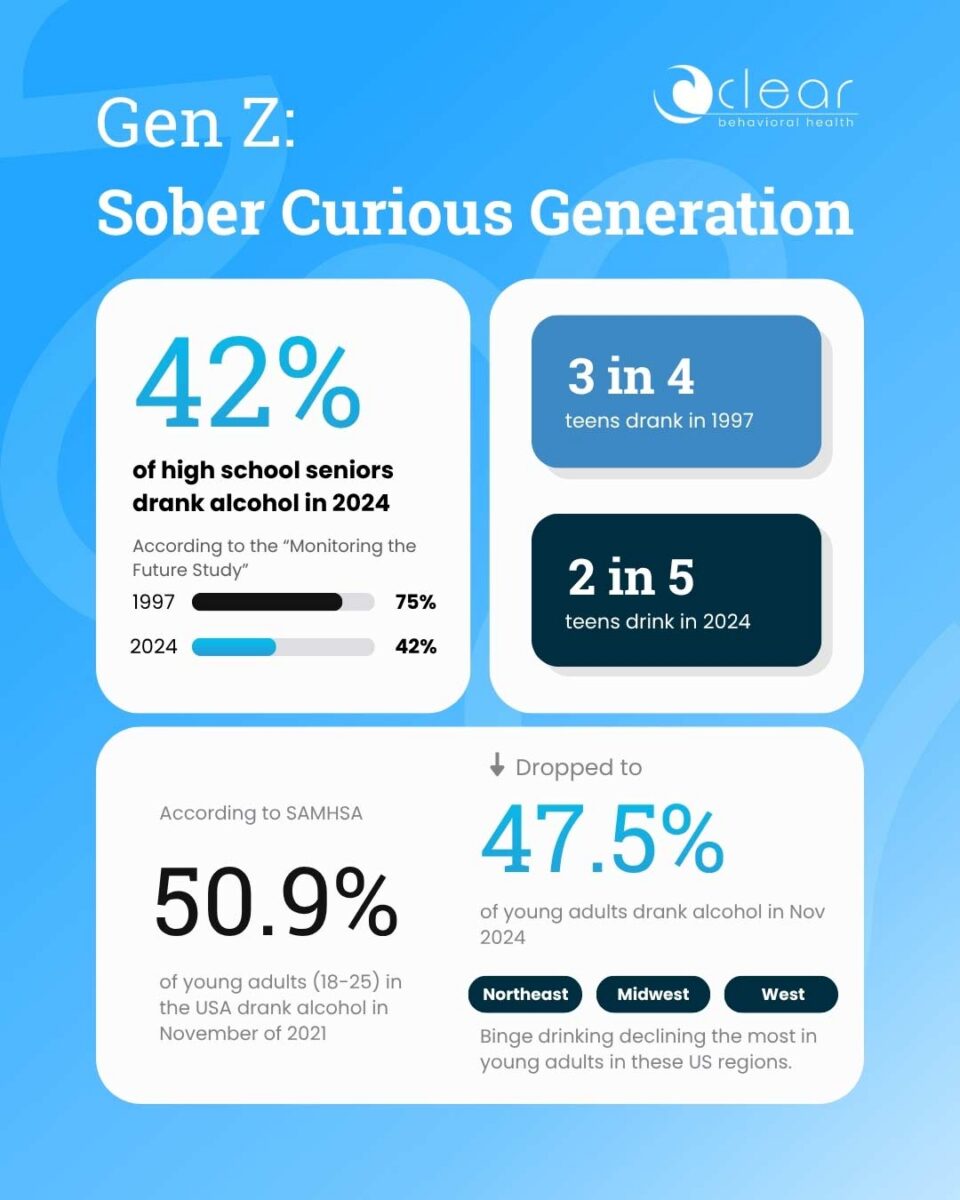
According to a recent Monitoring the Future study, only 42% of 12th graders reported any alcohol use during 2024. This is a massive drop, down from 75% as reported in 1997.[3]
These trends mirror a recent SAMHSA report indicating a shift in behavior among young adults. [4] According to this report, “past-month” drinking among young adults dropped from 50.9% in 2021 to 47.5% in 2024. [4] Although these trends aren’t as pronounced among underage populations, many of those surveyed who are of legal drinking age indicated a decrease in binge drinking, especially across the Northeast, Midwest, and Western portions of the United States.
Why Is Gen Z Drinking Less?
Research indicates that there are likely several reasons why today’s young adults are drinking less than their same age group did a decade ago.
Increased Mental Health Awareness
Growing concern over the health risks of alcohol is a significant factor. More young adults are reporting the belief that even moderate drinking is bad for their health. Gen Z seems to be more conscious of their physical and mental health than previous generations. Many of them want to maintain their sense of control and well-being, which is difficult to do when you’re drinking.
Among this generation, there seems to be less pressure to conform. Therefore, there may be less peer pressure to drink and a fading stigma around being sober. People no longer bat an eye when someone chooses not to drink at a social event.
More Focus on Wellness
Wellness culture is also flourishing, and health and fitness influencers are gaining popularity across social media platforms. Digital socialization has continued to push health trends across social media feeds, heightening awareness and spreading the message that drinking alcohol leads to all sorts of avoidable physical and mental health problems.
Financial Pressures
Also, alcohol is expensive. Many young people are struggling to make ends meet. These financial pressures mean that unnecessary expenses are often the first things to be cut from the budget (like alcohol). Perhaps on a related note, there is increasing pressure to perform professionally (which can be more difficult to do when drinking regularly). These findings are not only true for young adults in the United States, but in other countries too.[5]
How Alcohol Affects Mental Health
Alcohol is a depressant, and it quickly disrupts your brain chemistry by initially causing a temporary rush of serotonin and dopamine.[6] This means that the effects of alcohol may initially be relaxing, but they don’t last very long.
The first drink or two may bring momentary relief. However, long-term misuse can lead to worsening depression, anxiety, and other mood disorders. This is because chronic alcohol use leads to a depletion of “feel-good” neurotransmitters. The relationship between chronic alcohol use and mental illness is reciprocal. While alcohol can lead to mental health conditions, preexisting anxiety, depression, and other mental health concerns can worsen with continuing alcohol use.
Alcohol use is also a major risk factor for suicide.[7] Studies find that drinking alcohol may lead to suicidal ideation and attempts by decreasing inhibition, increasing impulsivity, and impairing judgment. [8] Alcohol dependence increases the risk of suicide up to 10 times when compared to the general population. Additionally, over 30% of suicide attempts involve alcohol intoxication.
Related: The Relationship Between Alcohol and Depression
What About Co-Occurring Disorders?
This struggle is especially difficult for those who may have underlying mental health issues alongside alcohol use disorder. This is known as dual diagnosis or co-occurring disorders. In these situations, a person may start using alcohol as a way to cope with their mental health (like anxiety or depression). [9] While it may temporarily offer relief, alcohol will eventually worsen those symptoms they may be trying to treat.
This creates a negative feedback loop, which makes it very difficult for someone to properly manage their symptoms without professional support or intervention. In such cases, a comprehensive treatment program tailored to address both the underlying mental health and substance use disorders can provide the best path forward towards long-term recovery.
Related: What is Dual Diagnosis?
Important Reality Check
While today’s generation may drink less overall, this does not mean that addiction is cured or is “gone.” High-risk groups still exist, especially those who are dealing with mental illness, trauma, and societal and economic pressures. [10] Overall, they may not be drinking as often as their older counterparts, but there are still some young adults who struggle.
As Keefer Wurmstich, CADC, the Regional Director of Outpatient Services for Clear Behavioral Health, states:
“While Gen Z drinking is decreasing we are seeing more and more Gen Z folks seeking treatment for drug use. One of the reasons is the ease of access of legal substances such as Kratom, Kava, and nitrous, which are often available at most smoke shops.”
For example, although binge drinking patterns are lower than those for other generations, there is still a significant number of Gen Zers who do binge drink. Binge drinking is usually defined as drinking at least 4 alcoholic drinks per occasion, or drinking in a way that results in a blood alcohol concentration of 0.08%.[11]
Binge drinking is also a possible sign of alcohol use disorder. Alcohol use disorder is a medical condition characterized by an inability to control or stop one’s alcohol consumption, despite the negative consequences to their health, work, and relationships. [12] In many cases, treatment through medical intervention, community support, and individual therapy is necessary to help people recover.
What This Means for Prevention & Treatment
Alcohol use disorder is a serious, complex issue that requires effective treatment for successful recovery. Early intervention matters because it can improve your chances of achieving successful sobriety before risky drinking patterns escalate into severe addiction that is often much harder to treat. By acting early and getting to the root of your problems, you can prevent permanent damage to your health and learn positive coping skills.
We understand that the challenges that Gen Z faces are complex. Addressing any underlying mental health issues alongside alcohol use disorder is an important way to reduce your risk of substance abuse. This is best done through structured care and professional treatment settings.
The Levels of Structured Care in Professional Addiction Treatment
When alcohol use begins to interfere with mental health, relationships, or daily life, professional treatment may be necessary.
Structured care can improve your outcomes by providing you with a stable framework to help you manage your addiction and your physical and psychological symptoms. It begins with professional medical supervision during your initial withdrawal phase. Over time, you can learn the psychological skills necessary to achieve long-term sobriety.
The steps of structured care are as follows:
- Detox (medical stabilization) – Alcohol detox provides professional medical and nutritional support while you safely clear alcohol from your body.
- Residential Treatment – Residential addiction treatment provides a structured, 24/7 program where you live at a facility to focus on recovery. These programs are usually for 30 to 90 days.
- Partial Hospitalization Program (PHP) – Partial hospitalization programs offer intensive “day treatment,” which includes several hours of daily therapy, 5 to 7 days per week. Overnight stay is not required.
- Intensive Outpatient Program (IOP) – These therapeutic programs allow you to focus on recovery while you continue to live at home. They offer high-level intensive individual, group, and family therapy sessions without requiring 24/7 care.
If alcohol is affecting your life or mental health, support and treatment are available. Contact our team of experts today, and we’ll guide you through the next steps.
Encouraging Trends, But Support Still Matters
There are positive signs involving trends among Gen Z and alcohol use disorder. Overall, this generation seems more aware of the risks associated with alcohol and is taking a more proactive approach to safeguard their physical and mental well-being. However, this movement doesn’t erase the reality that many young adults still struggle with addiction.
There is a continued need for mental health support, especially since mental illness remains a very real concern across all generations. If you or someone you know is struggling with an alcohol use disorder, you don’t need to go at it alone. Clear Behavioral Health offers comprehensive alcohol addiction treatment that includes medical detox and structured levels of care designed to support stabilization and recovery. The encouraging news is that help is available. With the right support, many people can rebuild their health, regain stability, and create a life that no longer revolves around alcohol.
Frequently Asked Questions
Why is Gen Z drinking less?
There are many reasons why Gen Z is drinking less. These include an increased focus on wellness, financial pressures, and more awareness of the risk of substance use.
Which generation drinks the most alcohol?
Millennials consume the most alcohol among recent generations (Z, X, and Baby Boomers), according to industry data. [13]
What does Gen Z drink instead of alcohol?
Mocktails and non-alcoholic drinks are popular among those who don’t drink or who are trying to cut back. [14] Sparkling water and wellness drinks are also very popular options among Gen Z.
Sources
- Surveillance Report #121 | National Institute on Alcohol Abuse and Alcoholism (NIAAA). (April 2024). https://www.niaaa.nih.gov/publications/surveillance-reports/surveillance121
- McHugh, R. K., & Weiss, R. D. (2019). Alcohol Use Disorder and Depressive Disorders. Alcohol research : current reviews, 40(1), arcr.v40.1.01. https://doi.org/10.35946/arcr.v40.1.01
- National Institute On Drug Abuse. (2024, December 17). Reported Use of Most Drugs among Adolescents Remained Low in 2024 | National Institute on Drug Abuse. National Institute on Drug Abuse. https://nida.nih.gov/news-events/news-releases/2024/12/reported-use-of-most-drugs-among-adolescents-remained-low-in-2024
- Substance Abuse and Mental Health Services Administration. (2025). 2021–2024 NSDUH data brief: Trends in substance use among young adults. https://www.samhsa.gov/data/sites/default/files/reports/rpt56978/2024-nsduh-data-brief-young-adult.pdf
- Di Censo, G., Thompson, K., Mittinty, M., & Bowden, J. (2026). OK Boomer: A longitudinal analysis unravelling generational cohort differences in alcohol consumption among Australians. Addiction (Abingdon, England), 121(2), 360–369. https://doi.org/10.1111/add.70201
- Costardi, J. V., Nampo, R. A., Silva, G. L., Ribeiro, M. A., Stella, H. J., Stella, M. B., & Malheiros, S. V. (2015). A review on alcohol: from the central action mechanism to chemical dependency. Revista da Associacao Medica Brasileira (1992), 61(4), 381–387. https://doi.org/10.1590/1806-9282.61.04.381
- Rahoof, F. V., Cherian, A. V., Kandasamy, A., Ezhumalai, S., & Dhanasekara, R. P. (2021). Suicidal Ideation among Persons with Alcohol Use Disorder: A Cross-Sectional Study. Journal of psychosocial well-being, 2(2), 30–41. https://doi.org/10.55242/jpsw.2021.2206
- Pompili, M., Serafini, G., Innamorati, M., Dominici, G., Ferracuti, S., Kotzalidis, G. D., Serra, G., Girardi, P., Janiri, L., Tatarelli, R., Sher, L., & Lester, D. (2010). Suicidal behavior and alcohol abuse. International journal of environmental research and public health, 7(4), 1392–1431. https://doi.org/10.3390/ijerph7041392
- Woody G. (1996). The Challenge of Dual Diagnosis. Alcohol health and research world, 20(2), 76–80. https://pmc.ncbi.nlm.nih.gov/articles/PMC6876494/
- Alhammad, M., Aljedani, R., Alsaleh, M., Atyia, N., Alsmakh, M., Alfaraj, A., Alkhunaizi, A., Alwabari, J., & Alzaidi, M. (2022). Family, Individual, and Other Risk Factors Contributing to Risk of Substance Abuse in Young Adults: A Narrative Review. Cureus, 14(12), e32316. https://doi.org/10.7759/cureus.32316
- Fillmore, M. T., & Jude, R. (2011). Defining “binge” drinking as five drinks per occasion or drinking to a .08% BAC: which is more sensitive to risk?. The American journal on addictions, 20(5), 468–475. https://doi.org/10.1111/j.1521-0391.2011.00156.x
- Wackernah, R. C., Minnick, M. J., & Clapp, P. (2014). Alcohol use disorder: pathophysiology, effects, and pharmacologic options for treatment. Substance abuse and rehabilitation, 5, 1–12. https://doi.org/10.2147/SAR.S37907
- Buchholz, K. (2023, September 8). Infographic: Gen Z: The More Sober Generation. Statista Daily Data. https://www.statista.com/chart/30783/alcohol-consumption-by-generation/
- Shriber, S. (2024, January 30). Gen Z Drives Mocktail Interest During Dry January and Beyond. CivicScience. https://civicscience.com/gen-z-drives-mocktail-interest-during-dry-january-and-beyond/