
Navigating mental health treatment can be overwhelming, and it often involves making tough decisions to ensure your needs are met. Inpatient mental health treatment is one option. However, many people confuse inpatient hospitals with residential programs (and vice versa). This article will help you understand the differences between these options so you can determine the appropriate level of care and get the support you deserve.
What Is Inpatient Mental Health Treatment?
Mental health treatment can occur in various settings. The level of care and environment depends on many factors, including your physical health, the severity of your condition, and the treatment necessary.
Psychiatric hospitals and residential treatment centers offer 24/7 care and are two levels of care within inpatient mental health treatment. However, each caters to different levels of patient needs (known as a spectrum of acuity).
Inpatient mental health treatment provides supervised care for those needing a high level of intensive support. Psychiatric hospitals are short-term, hospital-based, structured programs for people who are dealing with acute mental health crises or severe symptoms. Residential treatment centers, on the other hand, offer a less restrictive setting suited for individuals who need longer-term support but are no longer in immediate danger. Both levels of care include intensive medical supervision, therapy, and psychiatric care.
The goal is to stabilize patients who pose a risk to themselves or others. Inpatient may be a good fit for individuals who cannot manage their symptoms on their own and are experiencing a mental health crisis.
Some key aspects of inpatient treatment include:
- Safety and stabilization – The main goal of inpatient treatment is to ensure safety and stabilize the patient.
- Medical care – Care is provided 24/7 by a team of mental health specialists, including nurses, psychiatrists, and social workers.
- Structure – Patients follow a daily schedule that includes individual therapy, group therapy, and recreational activities.
- Duration – Inpatient mental health treatment is short-term and lasts from a few days to several weeks.
- Discharge planning – The goal is to stabilize the patient and plan for ongoing, lower-level care (like outpatient therapy).
While inpatient care is focused on crisis management, residential care is suitable for longer-term stays and non-hospitalized rehabilitation.
Struggling with your mental health? You don’t have to do it alone. Reach out to our experts today to learn more about inpatient mental health treatment.
What Is a Psychiatric Hospital?
When someone experiences a high-acuity mental health crisis that requires immediate stabilization, they may need to be admitted into a psychiatric hospital. Examples of such situations include:
- If they are in danger to themselves (or others).
- They are experiencing severe symptoms or unmanaged psychosis.
- They require rapid stabilization and quick medication changes.
- They need a structured environment to provide safety and intensive therapy.
Stays at a psychiatric hospital are typically short-term (several days to weeks). The goal is not to “cure” the condition, but to stabilize the patient and create a discharge plan for longer-term follow-up care.
What is the difference between voluntary and involuntary mental hospitalization?
There are two ways that someone is admitted to a psychiatric hospital. The first is through voluntary commitment. With voluntary commitment, you decide that you need treatment, walk into the facility, sign the papers, and ask for help.
The second way is through an involuntary psychiatric hold. This is when you are admitted into an inpatient mental health facility or hospital without providing your consent. This may happen if a licensed professional believes you could harm yourself or others.
What Is Mental Health Residential Treatment?
Residential mental health treatment provides the opportunity to focus on treating your mental health issues by working with mental health professionals. During your stay, you can also create mental health goals and shape new, healthy behaviors and coping skills.
The Key Characteristics of Residential Treatment
During residential treatment, you’ll focus on healing while building helpful life skills in a relaxed, home-like setting. It is an appropriate option for people dealing with various mental health conditions, including:1-5
- Anxiety disorders
- Severe depression
- Borderline personality disorder
- Bipolar disorder
- Trauma-related disorders
Residential treatment facilities are usually less clinical than inpatient psychiatric treatment and take place in a home-like setting. Stays here can last anywhere from 30 to 90 days, but some programs may be longer. Residents have access to 24/7 support and monitoring. However, the setting is less restrictive.
Services Provided at a Mental Health Residential Treatment Program
These inpatient programs offer many therapeutic activities tailored to meet your specific needs. This immersive experience includes:
- Comprehensive therapy, including individual, group, and family therapy, to understand the root causes of your condition.
- Life skills training and activities to help you relearn healthy habits.
- Medication management, including ongoing psychiatric oversight and monitoring to ensure your medications are safe, effective, and properly adjusted throughout your stay.
- Holistic and experiential activities like yoga, art therapy, and vocational counseling to enhance your well-being.
The goal of residential treatment is to help you successfully manage your symptoms while improving your well-being. You will be involved with evidence-based therapy programs while participating in daily structured activities geared towards healing physically and emotionally.
Related: What is Mental Health Residential Treatment?
How To Know Which Level of Care You Need
Hospitalization and residential care focus on improving your mental health. But how can you determine when someone needs inpatient care, and what factors lead to admission in a psychiatric hospital?
When Hospitalization Is Necessary
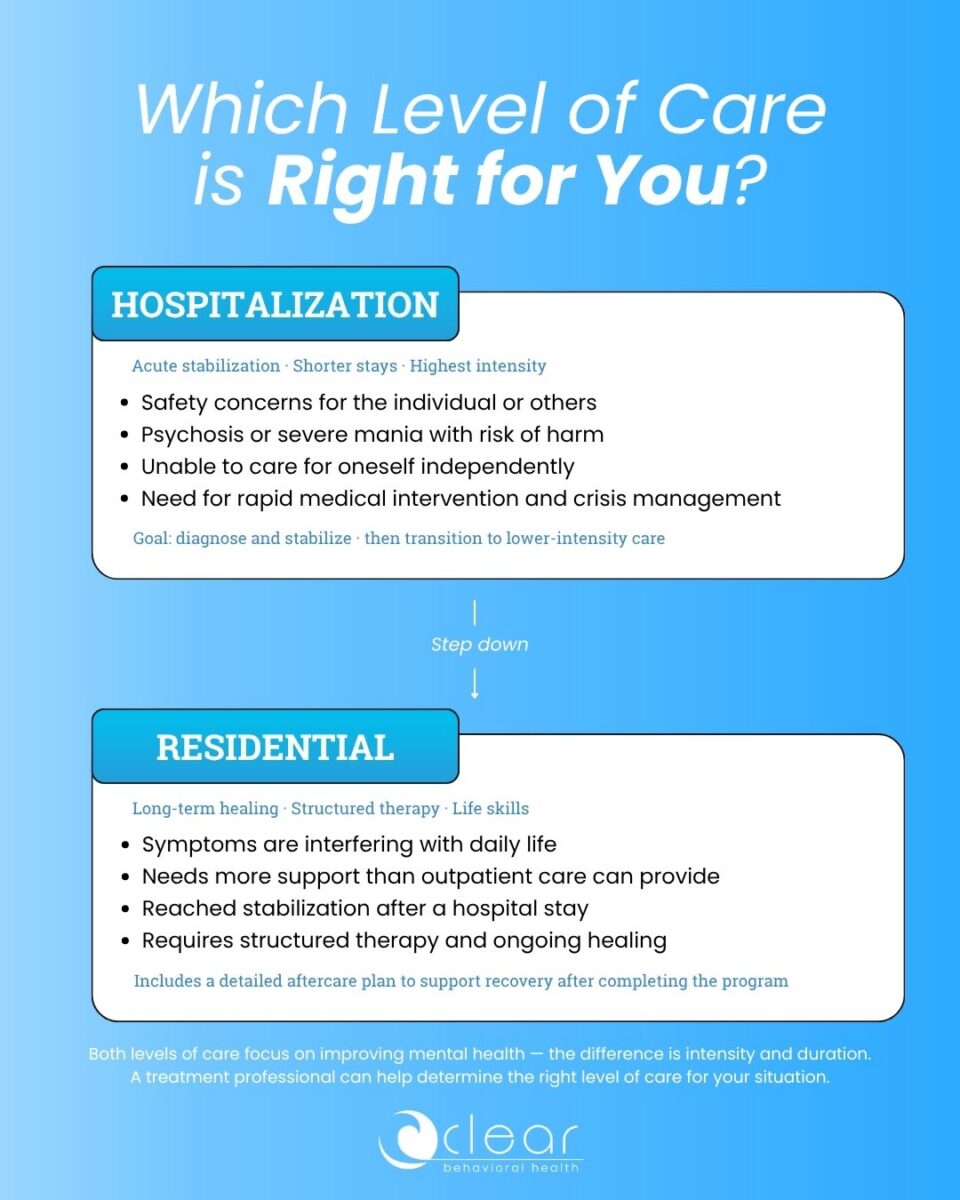
Hospitalization is appropriate when:
- There are safety concerns for the individual or those around them.
- They are experiencing psychosis or severe mania that puts themselves (or others) at risk of harm.
- They cannot care for themselves on their own.
- There is a need for rapid medical intervention, stabilization, and mental health crisis management.
The primary focus of hospitalization is to diagnose and stabilize those undergoing an acute mental health crisis. Stays at a psychiatric hospital are generally shorter, and the goal is to eventually move a patient into a less intensive treatment program, such as residential or outpatient treatment.
When Residential Care Is Appropriate
The focus of residential care isn’t stabilization, but more on improving a patient’s overall mental health and life skills. It is appropriate when:
- Symptoms are interfering with your daily life.
- You need a higher level of support than outpatient care.
- You’ve reached stabilization after hospitalization.
- You need structured therapy and long-term healing.
Residential care offers a higher level of support than outpatient treatment. You will also receive a detailed aftercare plan that supports your recovery after you complete the program.
Related: How to Know If You Need Inpatient Depression Treatment
What To Expect at CBH’s Residential Mental Health Programs
We understand how challenging it can be to struggle with severe mental illness. Clear Behavioral Health provides a safe, supportive environment for you to work on your journey towards healing and well-being. Here are some things you can expect when you stay with us.
Personalized Treatment Plans
No two people are exactly alike, which is why we offer unique treatment plans tailored to your needs. This level of personalization can help you achieve your wellness goals and develop the skills necessary to effectively manage your mental health.
24/7 Support in a Home-like Environment
We provide 24/7 medical supervision and access to therapy and psychiatric medication management. This ensures you receive the level of support you need so you can focus on getting better.
Individual, Group, and Family Therapy
At Clear Behavioral Health, our clients can work on their recovery from multiple angles. Individual therapy provides an opportunity to concentrate on your individual needs and goals. Group therapy shifts your focus towards building a community and sharing experiences with other residents. Family therapy can improve communication and repair bonds that may have become broken or damaged.
Holistic Care
During our program, you will have the ability to participate in classes and seminars that focus on mindfulness, nutrition, movement-based treatments, and other experiential therapies. These opportunities move beyond symptom management to treat your mind, body, and spirit.
Medication Management
Medication management is an important part of many mental health treatment plans. During your stay, your medications will be closely monitored with the help of our sister company, Neuro Wellness Spa, and adjusted as necessary to help you achieve long-term symptom management.
Amenities
It’s important to feel comfortable and at home in the space you’re living in. We provide many amenities that are designed to create a “home-like” therapeutic space for recovery. We offer private and semi-private rooms along with serene outdoor and garden areas where you can enjoy the fresh California air.
Healthy, nutritious meals are delivered daily with accommodations for specific dietary preferences. We also provide dedicated workout areas and on-site laundry facilities. Holistic activities (like yoga, meditation, sound baths, and art therapy) are regularly available, and you can also participate in life enrichment programming, including skill-building groups and wellness seminars.
Ready to support your mental health with compassionate, holistic therapy from our team of qualified providers? Contact us today to learn more about our treatment programs.
Continuum of Care for Lasting Wellness
Mental wellness is achieved through a progressive series of steps, from intensive 24/7 supervision to independent living and continuing mental health care. We see mental health as a long-term journey during which the level of support you need will shift as your needs evolve. Both hospitalization and residential care are important steps, but each serves different purposes. To learn more about their differences and which may be right for you, reach out to Clear Behavioral Health for an assessment today.
References
- National Institute of Mental Health. (2024). Anxiety disorders. National Institute of Mental Health. https://www.nimh.nih.gov/health/topics/anxiety-disorders
- National Institute of Mental Health. (2023, July). Major Depression. National Institute of Mental Health; National Institute of Mental Health. https://www.nimh.nih.gov/health/statistics/major-depression
- National Institute of Mental Health. (2024, December). Borderline Personality Disorder. National Institute of Mental Health. https://www.nimh.nih.gov/health/topics/borderline-personality-disorder
- National Institute of Mental Health. (2024). Bipolar Disorder. National Institute of Mental Health. https://www.nimh.nih.gov/health/topics/bipolar-disorder
- SAMHSA. (2014). Understanding the Impact of Trauma. National Library of Medicine; Substance Abuse and Mental Health Services Administration (US). https://www.ncbi.nlm.nih.gov/books/NBK207191/