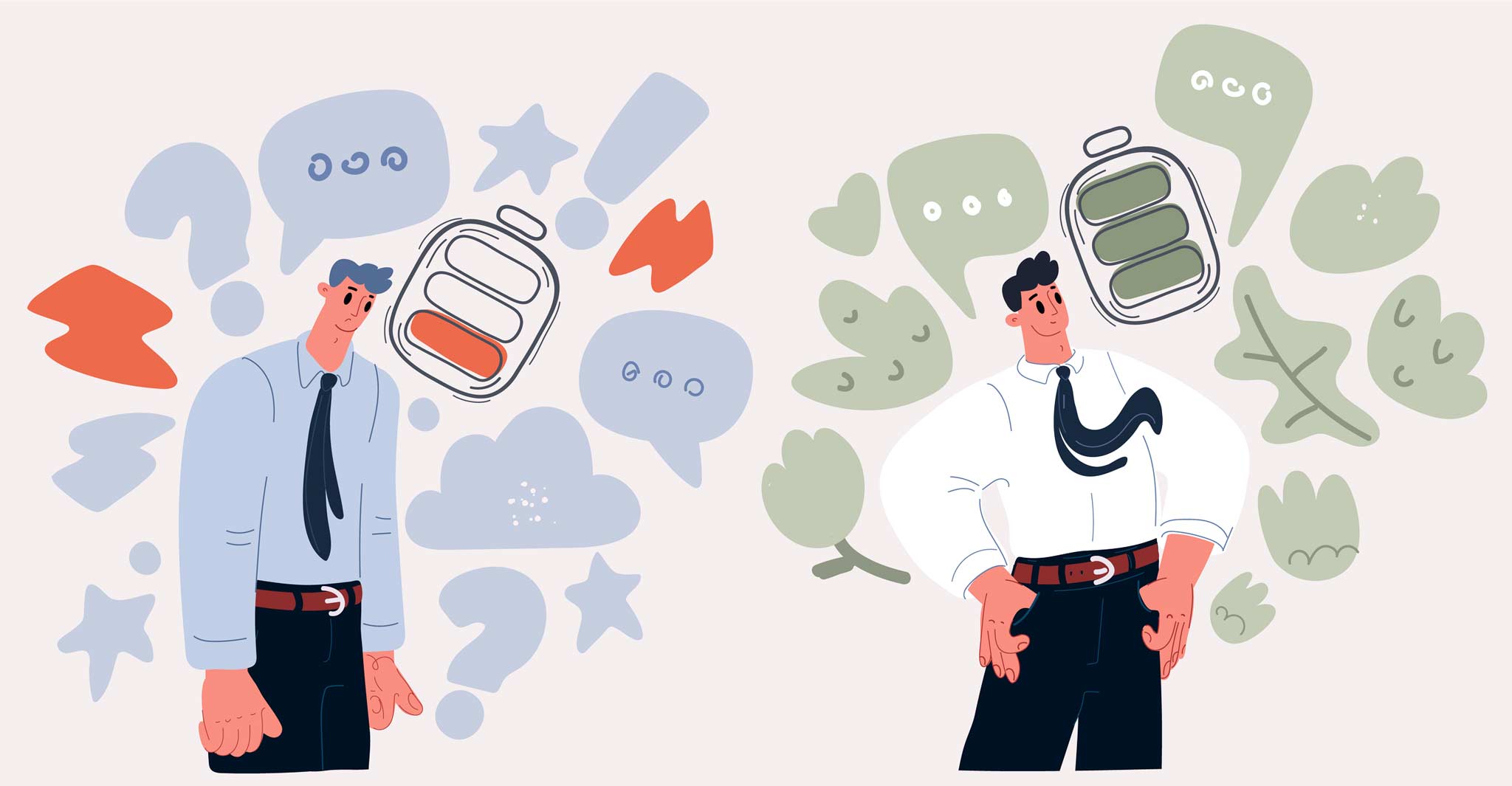
Are you exhausted, mentally drained, and unable to meet the demands of work, school, and your family life? If so, you may be experiencing burnout. Although it may feel impossible right now, you can recover. By understanding why you feel the way you do and knowing when to seek professional help, you can create a plan for burnout recovery.
Learn how to recover from burnout with the help of our compassionate mental health professionals. Reach out today to discover more about our programs and how we can help you improve your mental health.
What Is Burnout?
Burnout goes much deeper than just physical fatigue. It is a state of physical, mental, and emotional exhaustion that develops when you’re exposed to prolonged chronic stress and too many responsibilities at work. While burnout can share some features with depression or anxiety, it develops specifically in response to occupational health pressures and ongoing work demands.
Healthcare workers experience high rates of burnout, with approximately one in three physicians experiencing it at any given time.1 Other high-risk occupations include firefighters and air traffic controllers. However, anyone can develop burnout, no matter their job.2
What Are the Signs You May Be Headed Towards Burnout?
Burnout doesn’t just happen overnight. It takes time to manifest. Over time, you may develop several warning signs, including physical, emotional, and cognitive burnout symptoms.
Early Physical Symptoms of Burnout
Most people’s first clue that they’re heading towards burnout is physical symptoms. For example, you may start feeling drained all the time, even after a good night’s sleep. Because stress weakens your immune system, you might find yourself getting sick more often.3 Constant worry, racing thoughts, and problems with sleep are also common.
Early Emotional and Cognitive Symptoms
Many people at risk of burnout experience brain fog and an inability to focus on their tasks. Small inconveniences feel completely overwhelming, and you may start losing interest in work you once found meaningful. Feeling cynical, negative, and emotionally numb are also early warning signs worth paying attention to.
What Are the Signs and Symptoms of Active Burnout?
As burnout intensifies, your early symptoms may worsen, and new ones can develop. Here’s what severe burnout can look like across your body and mind.
Physical Symptoms of Active Burnout
Sleep disturbances are a major physical symptom of active burnout. This includes struggling to fall asleep, stay asleep or experiencing non-restorative sleep, which means you wake up feeling just as drained as when you went to bed. Poor sleep habits often worsen during this phase, making quality sleep feel out of reach.
You may also develop muscle aches and pains throughout your body. Tension headaches and jaw pain from clenching your teeth may also develop.
Some people experience frequent stomachaches, nausea, constipation, or diarrhea. Appetite fluctuations (completely losing one’s appetite to actively craving comfort foods) are also common signs of active burnout.
Emotional and Cognitive Burnout Symptoms
Active burnout deeply affects your executive functioning. It becomes harder to think clearly, multitask, or concentrate. You may overlook details, make more mistakes than usual, and have a hard time making decisions (even simple ones). Misplacing items and struggling with memory issues are also common.
During active burnout, your nervous system is in overdrive. You may feel completely emotionally depleted and have trouble regulating your emotions. Everything (and everyone) begins to get under your skin, and your tolerance for minor inconveniences decreases. Apathy and cynicism may cause you to feel helpless, overwhelmed, and trapped. Over time, you may fall into negative thinking patterns, which can significantly affect your mental health and your personal relationships.
Related: 12 Stages of Burnout
What Does Real Recovery From Burnout Look Like?
Recovering from active burnout looks less like a sudden breakthrough. Recovery has more to do with healing your physical and mental health symptoms while also creating healthy work boundaries and developing coping strategies that actually hold up over time.
Burnout is frustrating for so many people because others often think that a vacation, catching up on sleep, or quitting your job is all you need to feel better. While they can help temporarily, you must get to the root cause of your situation to recover.
Rest Is Necessary, but Usually Not Enough
There are several components to recovering from burnout, including:
- Prioritizing sleep and building better sleep habits
- Reducing your cognitive load
- Decreasing your commitments and saying no to too many responsibilities
- Limiting exposure to chronic stressors
- Giving yourself permission to do less
- Eating a healthy diet that supports your energy and mood
- Practicing relaxation techniques like deep breathing to calm your nervous system
- Building self-compassion so you can recover without added guilt
You don’t have to figure out burnout recovery on your own. If you’re not sure where to start, we’re here to help. Reach out to us today.
If you’ve been running on empty for months (or years), your symptoms may persist even when you aren’t at work or enjoying leisure time. Taking a vacation will only temporarily interrupt your stress. Once you’re back at work, it doesn’t take much time before you’re feeling exactly the same as before.
The Importance of Setting Healthy Boundaries
If you’re always available, have a hard time saying “no,” overcommit yourself, and never fully leave work mentally, working on healthy boundaries can significantly lighten your load. This can feel uncomfortable at first, but it’s one of the most effective stress management techniques available.
Some examples of healthy boundary setting include:
- Leaving work at a clearly defined time.
- Taking a real lunch break away from your desk (even a short one).
- Delaying email and text responses instead of immediately responding.
- Saying no to projects that are too big for your current workload.
- Allowing others to deal with their own consequences.
Many people build their identity around being dependable, helpful, and always available. This is why setting boundaries can be very difficult for some. A sign of recovery is when you’re able to objectively look at a task and ask yourself, “Am I capable of adding to my workload?” and decline when it’s too much.
Working on Your Identity
Workplace burnout doesn’t only happen because your workload becomes overwhelming. It often creeps up when you define who you are by what you do. When this happens, setbacks can feel deeply personal. It becomes nearly impossible to detach psychologically from work. When your identity is deeply intertwined with your job, the emotional toll can be severe.
It’s important to actively try to build a life that doesn’t revolve only around work. Try new hobbies, sign up for a class that’s completely different from your professional role, and explore who you are outside of the office. Having a support system outside of work, whether that’s friends, family, or a therapist, also provides the emotional support that makes recovery feel sustainable.
It’s also helpful to create a routine at the end of your workday so you can mentally detach. For example, you could close all your tabs, shut down your computer, immediately change from your work clothes once you’re home, and mute work-related notifications after hours.
Are you feeling overwhelmed by workplace burnout and in need of support? We’re here to listen.
Call us today to explore your burnout treatment options.
How Long Does Burnout Recovery Take?
One of the most common questions people have is how long recovery actually takes. The honest answer is that the burnout recovery timeline looks different for everyone, but here’s a general idea of what to expect:
- Mild burnout may improve in as little as 4 to 8 weeks with rest, boundary-setting, and reduced stress levels.
- Moderate burnout typically takes 3 to 6 months of consistent effort and self-care.
- Severe burnout, especially when it’s been building for a long time, can take 1 to 3 years to fully recover from.
- Working with a therapist can accelerate recovery significantly, sometimes by several months.
What matters most isn’t the timeline, but the consistency of your approach. Small, steady changes to your daily habits tend to produce more lasting results than any single dramatic shift.
Related: Burnout Therapy
When Does Burnout Become a Clinical Concern?
Although some can relieve burnout with rest, boundaries, and self-care, severe burnout can lead to mental health conditions, including clinical depression, anxiety, and dissociation.4 If not properly addressed, some people start to feel hopeless, worthless, and unable to feel joy. These could be signs of depression that deserve professional attention.5
Unmanaged burnout can also develop into an anxiety disorder.6 You might feel constantly “keyed up,” ruminate over worst-case scenarios, or experience panic attacks that prevent you from functioning as you normally would.
When your nervous system is constantly pushed past its limits, you may experience something called dissociation, which is a feeling of watching yourself from the outside or a dreamlike disconnection from reality.
When It’s Time to Seek Professional Help for Burnout
If burnout has pushed you past the point where rest and boundary-setting feel like enough, that’s exactly what we’re here for. At Clear Behavioral Health, we offer evidence-based burnout treatment through outpatient mental health programs designed to meet you where you are, including partial hospitalization programs (PHPs) and intensive outpatient programs (IOPs) that let you get meaningful support without putting your whole life on hold. If getting to an in-person program is a barrier, whether that’s location, schedule, or anything else, we also offer virtual treatment options so that help is always within reach.
You don’t have to stay burnt out or keep running on empty. With the right support, you can take real steps toward burnout recovery and get back to feeling like yourself again.
Ready to start your burnout recovery? Reach out to our team at Clear Behavioral Health today.
References
- De Hert S. Burnout in Healthcare Workers: Prevalence, Impact and Preventive Strategies. Local Reg Anesth. 2020 Oct 28;13:171-183. doi: 10.2147/LRA.S240564. PMID: 33149664; PMCID: PMC7604257. https://pmc.ncbi.nlm.nih.gov/articles/PMC7604257/
- Makara-Studzińska M, Kruczek A, Borzyszkowska A, Załuski M, Adamczyk K, Basińska MA. Profiles of Occupational Burnout in the Group of Representatives of High-Risk Professions in Poland. Int J Environ Res Public Health. 2022 May 22;19(10):6297. doi: 10.3390/ijerph19106297. PMID: 35627838; PMCID: PMC9141050. https://pmc.ncbi.nlm.nih.gov/articles/PMC9141050/
- Alotiby A. Immunology of Stress: A Review Article. J Clin Med. 2024 Oct 25;13(21):6394. doi: 10.3390/jcm13216394. PMID: 39518533; PMCID: PMC11546738. https://pmc.ncbi.nlm.nih.gov/articles/PMC11546738/
- Khammissa RAG, Nemutandani S, Feller G, Lemmer J, Feller L. Burnout phenomenon: neurophysiological factors, clinical features, and aspects of management. J Int Med Res. 2022 Sep;50(9):3000605221106428. doi: 10.1177/03000605221106428. PMID: 36113033; PMCID: PMC9478693. https://pmc.ncbi.nlm.nih.gov/articles/PMC9478693/
- National Institute Of Mental Health. (2024, December). Depression. National Institute of Mental Health. https://www.nimh.nih.gov/health/topics/depression
- National Institute of Mental Health. (2024). Anxiety disorders. National Institute of Mental Health. https://www.nimh.nih.gov/health/topics/anxiety-disorders