
The teenage years can feel like an emotional rollercoaster. Mood swings, irritability, and changing behavior are often a normal part of adolescence—but depression can look similar at first.
So how can you tell the difference?
Understanding what’s typical versus what may be something more serious can help you step in early and get your teen the right support.
Not sure if this is just a phase or something more serious? Call us today, and we’ll help you figure out what’s going on and what to do next.
Is My Child Depressed or Just Moody?
There are a few things to consider when determining if your teen is moody or actually depressed. Here’s a closer look at normal teen moodiness vs. depression.
Normal Teenage Behavior vs. Depression
Occasional sadness or mood swings are normal and pass pretty quickly. Maybe your teen is feeling low lately, but they’re still enjoying their favorite hobbies and talking to their friends.
However, maybe you’ve noticed that your teen is persistently angry or sad and no longer has interest in their favorite things. If you’ve noticed these changes for two weeks or longer, it could be a sign of depression.1
Related: Teenage Mood Swings & When To Seek Professional Help
What are the Signs of Depression in Teens?
Everyone gets sad or moody sometimes, and many teens can work through these challenges on their own. However, if the sadness or anger lasts for at least two weeks and begins to affect their daily life, it could be a sign of something more serious.
How Can I Tell if My Teen Has Depression?
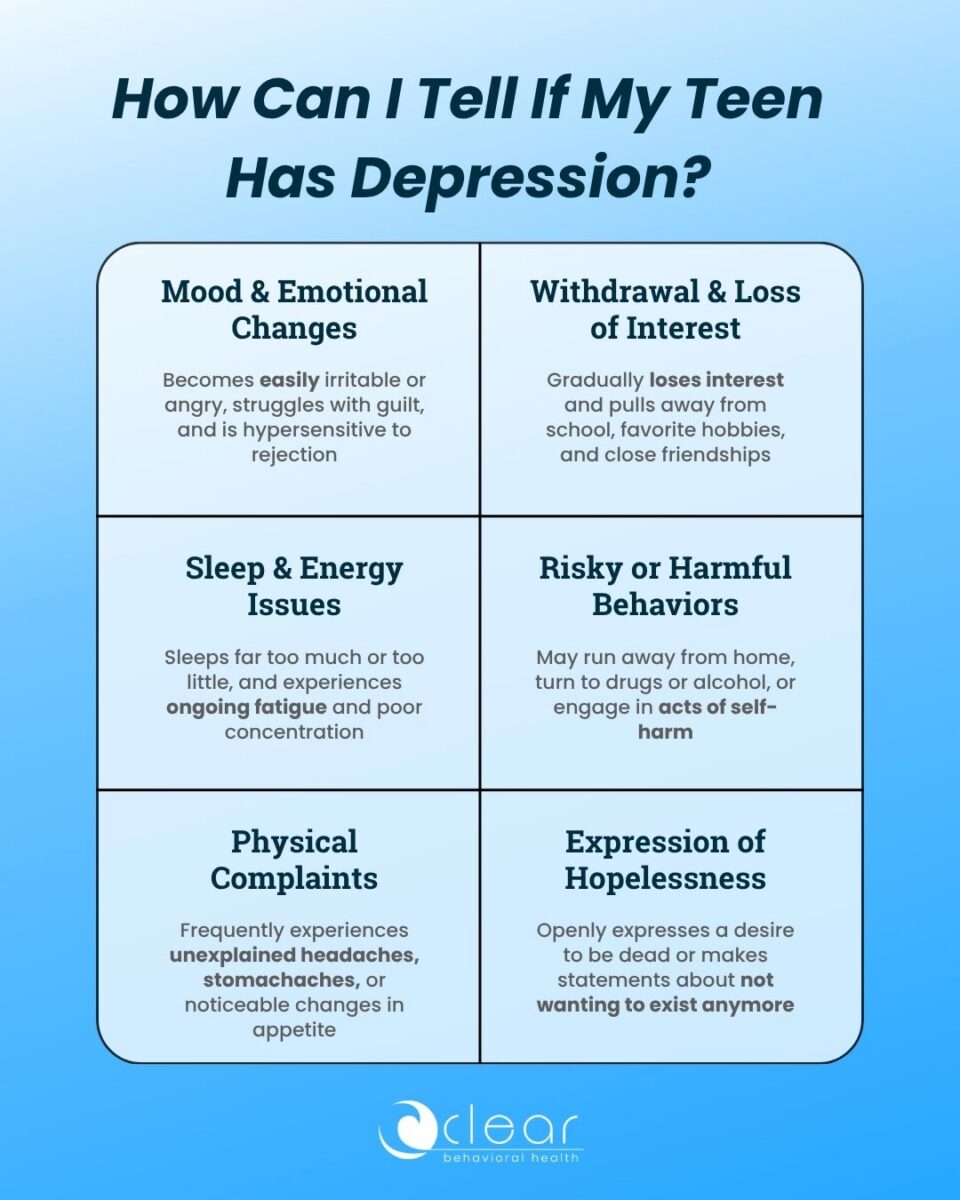
Depression affects how people think, feel, and act. Sometimes these signs are easy to miss. A teen experiencing depression may:
- Be easily annoyed or angry
- Struggle with feelings of guilt
- Have extreme sensitivity to rejection
- Lose interest and enjoyment in school, hobbies, and friends
- Sleep too little or too much
- Engage in risky behaviors (like running away or drug and alcohol use)
- Have low energy and a hard time concentrating
- Have a change in their eating habits
- Say things like “I wish I were dead.”
- Engage in self-harm
- Experience physical pain like stomachaches or headaches
Teen depression affects all areas of life. Without proper treatment, it can have serious consequences. Fortunately, there are evidence-backed treatment options that can help your teen start feeling better.
Related: 5 Early Signs of Depression in Teens
Is something off with your teen, but you can’t figure out what? We can walk you through what’s happening and help you decide if it’s time for support.
When To Get Emergency Help
Suicide is often associated with depression, and research shows that self-harm increases this risk.2
If your teen is talking about suicide, expressing a desire to die, or is in immediate danger:3
- Call 911
- Go to your local ER
- Or contact the 988 Suicide & Crisis Lifeline
Related: Suicide Prevention: Navigating Thoughts and Available Resources
What Causes Depression in Teens?
Adolescence is a time of great changes, emotionally, socially, and physically. Teens struggle with a lot of pressure from their friends and school, which can feel overwhelming. This pressure to fit in and do well can sometimes contribute to depression. Other major factors include:
- Biological factors, including genetics, brain chemistry, and hormonal changes
- Physical health, such as chronic or serious illness, may trigger symptoms
- Environmental stressors, such as struggling with schoolwork
- Peer pressure, bullying, and difficulty fitting in
- Family conflict, such as divorce or an abusive home environment
- The death of a loved one or moving away from friends
- Pre-existing conditions like ADHD, anxiety, or eating disorders
- Low self-esteem and a tendency towards negative thinking patterns
- Drug and alcohol use
- Excessive screentime and cyberbullying
There is not a single cause for teen depression. It develops from a mix of environmental, psychological, and biological factors. Although it can happen to anyone, teens with a family history of depression are at higher risk, especially if their parent struggled with it as a child or teenager.4
Can Teens Overcome Depression?
Teen depression is not a sign of weakness. It is a medical condition that can be treated with appropriate therapies (medications and/or psychotherapy). These options can help manage symptoms.
If you think your teen is depressed, talk to them. Listen to what they have to say without judgment. Let them know that their feelings are valid and offer your support. By encouraging open conversations often, you help create a safe space where they can feel more comfortable talking with you about how they are feeling.
It can be hard to tell the difference between the normal ups and downs of being a teenager and teen depression. However, depression is real and should never be dismissed as a teenage mood swing. Your child’s mental health is just as important as their physical health. If you’re noticing behavioral patterns that indicate your teen is struggling or that life seems overwhelming, then it may be time to seek professional help.
Find comfort knowing your teen’s depression is being taken care of by compassionate professionals and evidence-based treatment. Call us today for a clear, honest answer about what your teen might need.
Teen Depression Treatment Options
Depression is not a phase. It is a real mental health condition that requires compassionate support from mental health professionals.
Effective treatment for depression often involves a combination of therapy, lifestyle changes, and, if necessary, medication. Talk therapy and structured treatment programs offer the most effective support.
Clear Behavioral Health provides several options for teenagers struggling with depression. Our programs are tailored to provide support as they participate in individual and group therapy. Through our programs, your teen can develop useful tools to help them learn emotional regulation and communication skills.
Teen IOP at Clear Behavioral Health
Our teen intensive outpatient program is designed to help your child build coping skills, manage challenges, and heal with the support of their families and peers. Some of our offerings include:
- Personalized therapy and case management
- Medication management (if necessary) through adolescent psychiatry services provided by our sister company, Neuro Wellness Spa
- Supportive daily group therapy and holistic healing practices
- After school scheduling and school coordination
- Family therapy and parent counseling
Clear Behavioral Health believes in using evidence-based therapies that work. We offer group therapy, individual therapy, cognitive-behavioral therapy, dialectical behavior therapy, and other methods to help teenagers challenge their negative thinking patterns. Your teen will learn new, healthier ways to cope that can help them start feeling better.
Why Early Treatment Matters for Depressed Teens
Depression is a common mental health condition among teenagers, and it typically does not resolve on its own without support. [5] When left untreated, depression can interfere with school, relationships, and emotional well-being and may increase the risk of more serious outcomes over time. With early, appropriate care, teens can feel better, rebuild confidence, and reduce the likelihood that symptoms will continue into adulthood.6
How Lifestyle Changes Can Help Your Teen
Professional therapy is just one part of the solution. You can also help your teen make healthy lifestyle changes to improve their depression symptoms. If your teen isn’t depressed and they really may be just going through a phase, these lifestyle changes can still help lift their spirits.
Regular Exercise
Moving your body is a powerful way to boost your mood. Exercise triggers the release of neurotransmitters that create a sense of well-being and are important for emotional balance.7 Encourage them to stay active with activities they enjoy, like dancing or biking.
Consistent Sleep
Sleep also plays a part in lowering depression symptoms.8 Sleep deprivation increases activity in your brain’s emotion center and decreases activity in the area responsible for decision-making. Getting your teen’s sleep schedule on track is a simple but powerful way to affect their mood. Consider creating a “tech curfew” about an hour before their bedtime. The blue light from screens can interfere with melatonin production, making it more difficult to fall asleep.9
Healthy Eating Habits
Your teen’s diet also plays an important role in managing their depression symptoms.10 By providing them with nutritious meals and avoiding highly processed foods, you can also prevent the energy crashes that are associated with mood swings. A diet that’s focused on fruits, vegetables, fatty fish, and whole grains can improve some depression symptoms by reducing inflammation.11
Healthy Social Connections
Depression is lonely and isolating. Many teens experiencing depression may stop calling their friends and family. Unfortunately, self-isolation creates a negative feedback loop, worsening their symptoms as they continue to withdraw.
If you notice these behaviors from your teen, encourage them to create social connections, whether it’s joining a new club at school or playing soccer at the park with friends. These friendships can help them feel less alone and distract them from negative thought patterns.
Not sure if this is a phase or something more? Our teen mental health experts are here to help and support your family. Talk with our specialists today.
Get Support for Teen Depression at Clear Behavioral Health
Watching your teen struggle with depression can feel heartbreaking and overwhelming. You may be unsure where to turn or how to help, but support is available.
At Clear Behavioral Health, we provide compassionate, evidence-based care designed specifically for teenagers and their families. Our teen depression programs focus on helping teens understand their emotions, develop healthy coping skills, and rebuild confidence in a supportive, structured environment.
Whether your teen needs a higher level of care or more flexible outpatient support, our experienced clinicians work closely with families every step of the way. With the right treatment and guidance, teens can heal, regain stability, and reconnect with the people and activities they enjoy.
If you’re concerned about your teen’s mental health, don’t wait. Contact Clear Behavioral Health today to take the first step toward hope, healing, and lasting support.
Frequently Asked Questions
Does my teenager have depression?
It can be hard for parents to know if a teen has depression or if it’s normal teen moodiness. If you are wondering if your teen has depression, the best course of action is to make an appointment with a mental health professional for an assessment.
What are the signs my teen is depressed?
Signs your teen may be depressed include irritability, sadness, changes in appetite or sleep, difficulty concentrating, low energy, and a change in performance at school. For depression, these symptoms persist for at least two weeks. They also go beyond typical teen moodiness.
Why is my teen depressed?
Many things can trigger teen depression, including hormones, stressors, and social pressure. There is rarely one single cause of depression.
References
- Substance Abuse and Mental Health Services Administration. DSM-5 Changes: Implications for Child Serious Emotional Disturbance [Internet]. Rockville (MD): Substance Abuse and Mental Health Services Administration (US); 2016 Jun. Table 9, DSM-IV to DSM-5 Major Depressive Episode/Disorder Comparison. Available from: https://www.ncbi.nlm.nih.gov/books/NBK519712/table/ch3.t5/
- Ernst, M., Kallenbach-Kaminski, L., Kaufhold, J., Negele, A., Bahrke, U., Hautzinger, M., Beutel, M. E., & Leuzinger-Bohleber, M. (2020). Suicide attempts in chronically depressed individuals: What are the risk factors? Psychiatry Research, 287, 112481. https://doi.org/10.1016/j.psychres.2019.112481
- 988 Lifeline. (2024). Get Help. 988 Lifeline; 988 Lifeline. https://988lifeline.org/get-help/
- Shadrina M, Bondarenko EA, Slominsky PA. Genetics Factors in Major Depression Disease. Front Psychiatry. 2018 Jul 23;9:334. doi: 10.3389/fpsyt.2018.00334. PMID: 30083112; PMCID: PMC6065213. https://pmc.ncbi.nlm.nih.gov/articles/PMC6065213/
- Wisdom JP, Clarke GN, Green CA. What teens want: barriers to seeking care for depression. Adm Policy Ment Health. 2006 Mar;33(2):133-45. doi: 10.1007/s10488-006-0036-4. PMID: 16489480; PMCID: PMC3551284. https://pmc.ncbi.nlm.nih.gov/articles/PMC3551284/
- Long-term Depression Treatment Leads to Sustained Recovery for Most Teens. (2009, November 18). National Institute of Mental Health (NIMH). https://www.nimh.nih.gov/news/science-updates/2009/long-term-depression-treatment-leads-to-sustained-recovery-for-most-teens
- Hossain MN, Lee J, Choi H, Kwak YS, Kim J. The impact of exercise on depression: how moving makes your brain and body feel better. Phys Act Nutr. 2024 Jun;28(2):43-51. doi: 10.20463/pan.2024.0015. Epub 2024 Jun 30. PMID: 39097997; PMCID: PMC11298280. https://pmc.ncbi.nlm.nih.gov/articles/PMC11298280/
- National Heart, Lung, and Blood Institute . (2022, June 15). Sleep Deprivation and Deficiency – How Sleep Affects Your Health | NHLBI, NIH. Www.nhlbi.nih.gov; National Heart, Lung, and Blood Institute. https://www.nhlbi.nih.gov/health/sleep-deprivation/health-effects
- Sanchez-Cano A, Luesma-Bartolomé MJ, Solanas E, Orduna-Hospital E. Comparative Effects of Red and Blue LED Light on Melatonin Levels During Three-Hour Exposure in Healthy Adults. Life (Basel). 2025 Apr 28;15(5):715. doi: 10.3390/life15050715. PMID: 40430143; PMCID: PMC12113466. https://pmc.ncbi.nlm.nih.gov/articles/PMC12113466/
- Liu H, Li X, Shi Y, Hong K, Wang X, Huang C. Gut-brain axis in adolescent depression: a systematic review of psychological implications and behavioral interventions. Front Nutr. 2025 Sep 4;12:1644245. doi: 10.3389/fnut.2025.1644245. PMID: 40977983; PMCID: PMC12443687. https://pmc.ncbi.nlm.nih.gov/articles/PMC12443687/
- Abdel Sater RF, Younes RS, Julien SG. Examining the association between the Mediterranean diet and depression: a cross-sectional study in Lebanon. Front Nutr. 2025 Dec 17;12:1692981. doi: 10.3389/fnut.2025.1692981. PMID: 41479663; PMCID: PMC12753428. https://pmc.ncbi.nlm.nih.gov/articles/PMC12753428/