

Wondering what detox is like and how long it takes? The truth is that the process looks different for everyone. Clear Behavioral Health offers safe and comfortable medical detox to help you start your recovery journey off right. Learn more about the timelines and stages of medical detox, as well as what to expect from our treatment program afterwards.
What Is Detox and Why Is It Important?
The earliest stage of recovery starts with medical detox. This first step happens before you enter a residential treatment program.
Detox is when your body eliminates harmful substances that it has become dependent on. During detox, you receive support from medical professionals who will keep you safe and comfortable as you medically stabilize.
Many people feel tempted to attempt detox on their own. However, this process can lead to uncomfortable and potentially dangerous symptoms, some of which can be life‑threatening without proper medical supervision. Sometimes, medications are also necessary to keep you safe.
Ready to take the first step to true recovery? Contact us to speak with a recovery professional and start the treatment process today.
How Long Does Detox Take?
Detox can take anywhere from 5 to 14 days or longer, depending on the substance and other factors.
How Long Do Withdrawal Symptoms Usually Last?
The timeframe of withdrawal symptoms depends on several variables, including:
- Substance – Different substances remain in the body for different lengths of time. They also produce different withdrawal symptoms.
- Duration of use – The longer someone uses, the longer detox will likely take. This is because of cumulative effects and changes in the brain and body.
- Dosage – Frequent substance use and higher doses increase physical dependence. This can intensify and prolong withdrawal symptoms.
- Physical or mental health considerations – Those with anxiety, depression, or other psychiatric disorders may experience worse withdrawal symptoms. Chronic health conditions can also make the process more complex.1
Detox is not one-size-fits-all. While some people need a few days to complete the process, others need weeks of monitoring and medical support.
What Are the Stages of Detox?
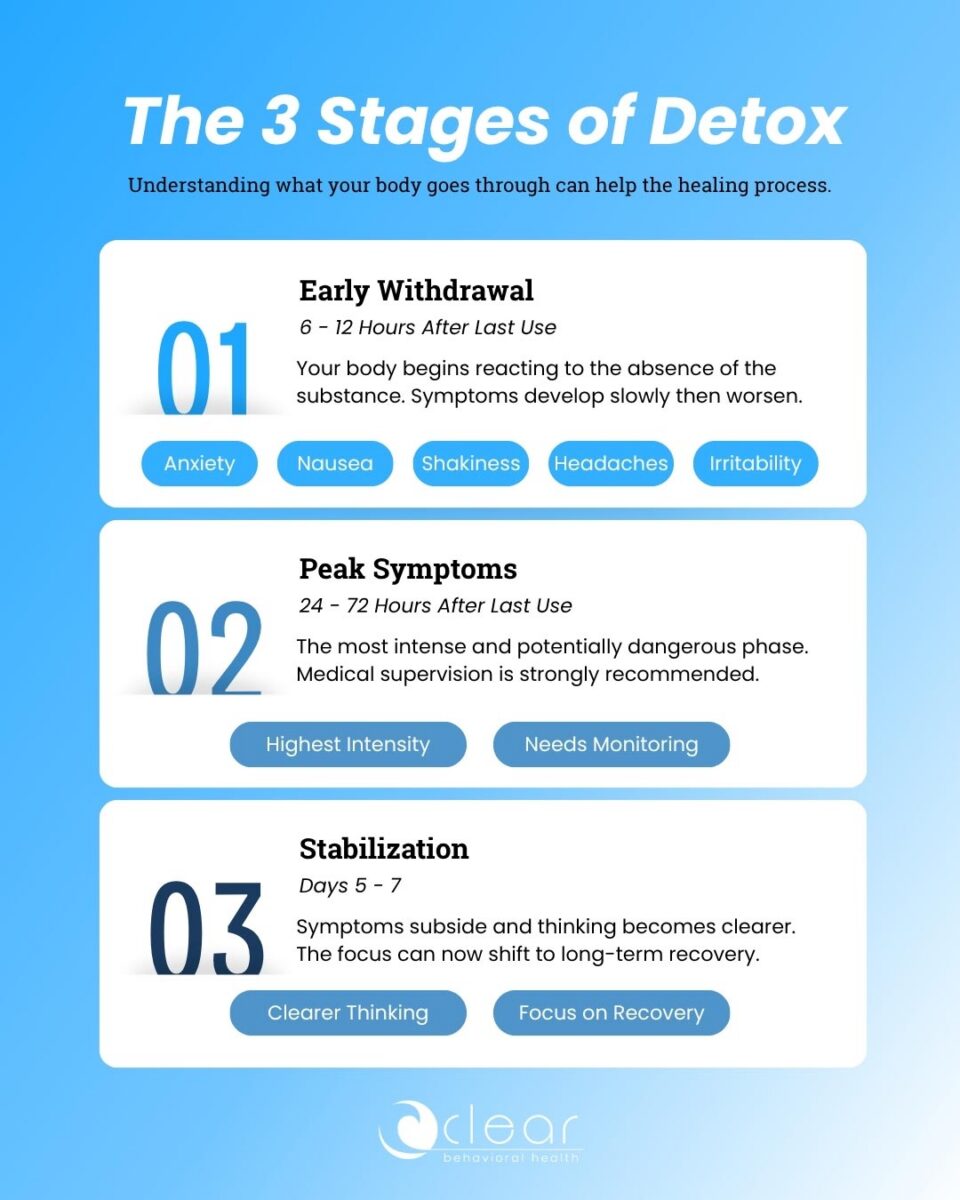
There are three phases of detox. Withdrawal symptoms often begin within just a few hours, reach maximum intensity in a few days, and then stabilize.
Early Withdrawal
Early withdrawal begins 6 to 12 hours after your last use.2 This phase occurs when your body starts to react to the absence of drugs or alcohol. These symptoms may develop slowly but quickly worsen. They can include anxiety, nausea, shakiness, headaches, and irritability.
Peak Symptoms
For many, symptoms are the hardest between 24 and 72 hours after last use. This is the most intense (and potentially dangerous) phase.
Stabilization
After the most intense symptoms subside, you’ll eventually reach stabilization. This phase occurs between 5 and 7 days after detox begins. At this point, you may begin to feel more comfortable and clear-headed. Now, your focus can shift to long-term recovery.
When Do Detox Symptoms Peak?
Depending on the substance, withdrawal symptoms peak around 1 to 3 days after your last use.3 Alcohol and short-acting opioids may peak within a few days, but long-acting opioids and benzodiazepines may take longer.
What Happens on Day 3 of Detox?
From day 1 to day 3, you may experience tremors, intense cravings, vomiting, fever, and severe anxiety. Symptoms can range in severity based on factors like frequency, duration, and heaviness of use. Hallucinations and seizures are also possible.
These symptoms occur because your central nervous system becomes extremely active as your body begins to struggle without the substance. This phase is known as the “danger zone” and is why medical detox is highly recommended.
Detox Timeline by Substance
Your detox timeline depends on various factors, primarily the type of substance you used. Here is a general timeline for some of the most common substances people seek treatment for.
Alcohol Detox Timeline
Alcohol detox is high-risk. It can be life-threatening without medical treatment. Over time, your central nervous system becomes used to constantly having alcohol around. Because alcohol has a depressive effect on your brain function and nerves, your body may work harder to keep functioning.
If you drink heavily and frequently enough, you will likely experience mental and physical symptoms when you try to cut back or stop drinking. These can include shakiness, increased anxiety, and heart palpitations. Hallucinations and seizures may also occur. Symptoms of alcohol withdrawal may peak within 6 to 72 hours after onset and can last up to 7 days or longer.2
Related: How Long Does It Take To Detox From Alcohol? Stages and Timeline
Opioid Detox Timeline
Opioids include drugs like heroin, fentanyl, and prescriptions like Vicodin. The detox process is challenging and complex. As your body struggles to regain balance when opioids are no longer present, it leads to withdrawal symptoms.4 These symptoms begin anywhere from 6 to 72 hours after last use and can last up to 7 days or longer.
Physical symptoms vary depending on the person and level of dependency. However, they can include muscle aches, sweating and chills, nausea, runny nose, and increased heart rate and blood pressure.
The withdrawal process can last longer for fentanyl. This is because it is fat-soluble.5 This means that it can build up in your body fat and then slowly be released over time.
Related: A Guide to Opioid Detox
Benzodiazepine Detox Timeline
Medical supervision is vital when detoxing from benzodiazepines to manage potentially life-threatening risks. These risks include seizures, high blood pressure, and severe cardiac complications.
In a medically supervised detox, healthcare professionals will closely monitor you as they safely taper you off of benzodiazepines. A medical taper will decrease your chances of developing severe withdrawal symptoms.
Prolonged withdrawal from benzodiazepines is common, and the onset is slower. Your experience while detoxing from benzos can last for weeks to even months.6
Related: The Dangers of Benzo Detox and Xanax Withdrawal
Kratom Detox Timeline
Some people may abuse kratom if they are dealing with opioid withdrawal. However, kratom also carries its own risk for dependence and withdrawal.
Kratom detox tends to be milder in comparison to alcohol, opioid, or benzodiazepine detox. But there are still significant symptoms. Kratom detox usually takes between 3 and 10 days.7
The first symptoms that appear within 6 to 12 hours include a runny nose, sweating, muscle aches, and stomach discomfort. The acute withdrawal phase begins between 24 and 72 hours after last use and is similar to opioid withdrawal.8 This is because kratom interacts with the same receptors as opioids do in the brain.
As the more uncomfortable phase of withdrawal subsides, you may experience lingering fatigue or weakness, cravings, irritability, and insomnia. These psychological symptoms are hard to manage on your own without support.
What Day of Detox Is the Hardest?
The detox experience is different for everyone. However, the most uncomfortable physical symptoms usually peak during the first few days and then decrease.
However, insomnia, anxiety, and other physiological symptoms can last for weeks or longer. This is why we highly recommend professional support to help you safely navigate the early stages of sobriety and develop healthy coping mechanisms for cravings.
How Long Does It Take To Completely Detox Your Body?
The length of time it takes to completely detox your body depends on whether you’re talking about physical or psychological recovery. Physical detox usually takes 3 to 14 days to clear out substances and manage severe withdrawal symptoms.
Psychological recovery takes longer since it requires rewiring of your neural pathways. This process can take several months to a year. Also, while your physical symptoms may peak at 3 days and start decreasing in intensity afterwards, psychological symptoms like depression, cravings, and anxiety may last much longer.
Medically supervised detox prepares your body for healing. However, recovery continues long after withdrawal symptoms end. After medical detox, it’s important to continue the healing process with the help of an evidence-based substance abuse treatment program.
What Happens After Detox?
People have different needs after detox, which is why Clear Behavioral Health provides a full continuum of care to help you successfully navigate the next steps:
- Residential treatment
- Partial hospitalization program
- Intensive outpatient program
- Medication management
- Individual and group therapy
- Relapse prevention and aftercare
Each step can help you build stability, develop helpful coping skills, and provide you with the long-term support you need on your recovery journey. With Clear Behavioral Health, you can find your way to a healthier, substance-free future.
Related: From Detox to Aftercare: The Full Journey of Drug Rehab
How Long Is Someone Usually in Detox?
The length of time someone spends in detox depends on their individual recovery process timeline. These can differ for everyone, which is why individualized care is important.
With individualized care, you’ll receive a tailored plan that accounts for your specific medical, substance use, and physical health history. This enhances your safety by making sure that detox protocols are adjusted to manage your unique risks of experiencing severe symptoms (like seizures, dehydration, or delirium tremens).9
Start your path to recovery with our safe, medically supervised detox program. Contact our experts to begin the intake process and regain control of your life.
Start Your Detox Process With Clear Behavioral Health
You don’t have to face addiction alone. Research shows that alcohol and substance use disorders can be effectively treated with comprehensive recovery programs and continuing care.10
Recovery is in your reach when you begin your journey with Clear Behavioral Health. Our recovery programs start with a safe and medically supervised drug and alcohol detox, followed by highly personalized step-down programs designed to provide you with scientifically-based, whole-person care. Begin your healing process by speaking with one of our specialists today.
References
- Kelly TM, Daley DC. Integrated treatment of substance use and psychiatric disorders. Soc Work Public Health. 2013;28(3-4):388-406. doi: 10.1080/19371918.2013.774673. PMID: 23731427; PMCID: PMC3753025.
- Canver BR, Newman RK, Gomez AE. Alcohol Withdrawal Syndrome. [Updated 2024 Feb 14]. In: StatPearls [Internet]. Treasure Island (FL): StatPearls Publishing; 2026 Jan-. Available from: https://www.ncbi.nlm.nih.gov/books/NBK441882/
- Clinical Guidelines for Withdrawal Management and Treatment of Drug Dependence in Closed Settings. Geneva: World Health Organization; 2009. 4, Withdrawal Management. Available from: https://www.ncbi.nlm.nih.gov/books/NBK310652/
- Shah M, Huecker MR. Opioid Withdrawal. [Updated 2023 Jul 21]. In: StatPearls [Internet]. Treasure Island (FL): StatPearls Publishing; 2026 Jan-. Available from: https://www.ncbi.nlm.nih.gov/books/NBK526012/
- Luba R, Jones J, Choi CJ, Comer S. Fentanyl withdrawal: Understanding symptom severity and exploring the role of body mass index on withdrawal symptoms and clearance. Addiction. 2023 Apr;118(4):719-726. doi: 10.1111/add.16100. Epub 2022 Dec 13. PMID: 36444486; PMCID: PMC9992259.
- Ashton H. Protracted withdrawal syndromes from benzodiazepines. J Subst Abuse Treat. 1991;8(1-2):19-28. doi: 10.1016/0740-5472(91)90023-4. PMID: 1675688.
- Henningfield JE, Chawarski MC, Garcia-Romeu A, Grundmann O, Harun N, Hassan Z, McCurdy CR, McMahon LR, Sharma A, Shoaib M, Singh D, Smith KE, Swogger MT, Vicknasingam B, Walsh Z, Wang DW, Huestis MA. Kratom withdrawal: Discussions and conclusions of a scientific expert forum. Drug Alcohol Depend Rep. 2023 Mar 15;7:100142. doi: 10.1016/j.dadr.2023.100142. PMID: 37397437; PMCID: PMC10311168.
- Shah M, Huecker MR. Opioid Withdrawal. [Updated 2023 Jul 21]. In: StatPearls [Internet]. Treasure Island (FL): StatPearls Publishing; 2026 Jan-. Available from: https://www.ncbi.nlm.nih.gov/books/NBK526012/
- Grover S, Ghosh A. Delirium Tremens: Assessment and Management. J Clin Exp Hepatol. 2018 Dec;8(4):460-470. doi: 10.1016/j.jceh.2018.04.012. Epub 2018 May 5. PMID: 30564004; PMCID: PMC6286444.
- Substance Abuse and Mental Health Services Administration (US); Office of the Surgeon General (US). Facing Addiction in America: The Surgeon General’s Report on Alcohol, Drugs, and Health [Internet]. Washington (DC): US Department of Health and Human Services; 2016 Nov. CHAPTER 4, EARLY INTERVENTION, TREATMENT, AND MANAGEMENT OF SUBSTANCE USE DISORDERS. Available from: https://www.ncbi.nlm.nih.gov/books/NBK424859/