
Finding the right mental health program that fits your needs is an important first step in your mental health journey. For some, their journey starts with a partial hospitalization program (PHP) or an intensive outpatient program (IOP). Learn the key differences between these programs, their benefits, and how to determine which is right for you.
What Is a Partial Hospitalization Program?
Partial hospitalization programs are more intensive than IOPs. PHP is for those individuals needing a higher level of care, but do not need inpatient hospitalization.
PHPs have structured scheduling with sessions lasting most of the day, 5 days a week. This type of rigorous scheduling provides comprehensive care while allowing for patients to return home in the evenings.
How Long Does a PHP Typically Last?
PHPs usually last between 2 and 4 weeks. They are meant to be intensive, short-term programs. They are also highly flexible and tailored to your progress.
How Many Hours is PHP per Day?
PHP programming lasts longer than IOP does per day and requires a time commitment of at least 20 hours per week. Around 6 hours a day from Monday through Friday is typical. It is meant to serve as a “step down” from inpatient hospitalization or a “step up” from outpatient therapy.
What Is an Intensive Outpatient Program?
An intensive outpatient program is designed for those who need more support than traditional outpatient services but not 24/7 care. While it is structured, it is minimally intensive and usually involves daily therapeutic sessions lasting several hours. With this kind of scheduling, you may be able to continue working while still receiving the care you need to address personal challenges.
How Long Do People Stay in IOP?
IOPs often last between 8 and 12 weeks, depending on your needs and the program. Those with more complex cases or with co-occurring disorders (like mental health concerns and addiction) may require a lengthier program of 90 days or more.
How Many Hours Is IOP per Day?
Participants usually attend therapy sessions 3 to 5 days a week for several hours a day (often between 3 and 4), totaling about 9 to 15 hours of treatment per week.
Don’t let mental illness or addiction get in the way of living the healthy, full life you deserve. Our team is ready to help you. Contact us to get started on your healing journey today.
What Comes First: PHP or IOP?
In the continuum of mental health care and addiction recovery, partial hospitalization programs come first. PHPs are designed to be highly structured, intensive, full-day treatment programs without requiring an overnight stay. Afterwards, clients should transition into the intensive outpatient program level of care.
Transitioning from a PHP to an IOP ensures that clients receive a gradual decrease in care. This helps reduce the risk of symptom or addiction relapse.
Every person’s mental health journey is unique. A professional assessment is necessary to determine where your appropriate starting point might be. While some who are experiencing moderate symptoms begin with IOP, others may need to start with more intensive treatment.
Is PHP better than IOP?
No, they just offer different levels of care. PHPs are intensive, and often bridge the gap between inpatient treatment and outpatient care or provide a safe step up in care from traditional weekly therapy and medication management. PHPs also provide a structured setting that supports the continuity of care and reinforces daily routines essential for recovery.
Related: What is an IOP? PHP & IOP Treatment and How Can It Help Your Family
What Services Do PHP and IOP Include?
Before entering the program, each client will receive an in-depth assessment. This assessment allows the team to create a personalized care plan that is tailored to their goals, using evidence-based therapies like cognitive behavioral therapy, dialectical behavioral therapy, and mindfulness techniques.[1,2,3]
Both programs offer a core set of evidence-based treatment modalities and therapeutic services, including:
- Psychiatric evaluation (PHP)
- Medication management
- Individual and group therapy
- Family therapy
- Life skills training
The key distinction is in how these services are delivered. PHP places greater emphasis on psychiatric care, with a more structured, clinically supported environment suited for those who need intensive, daily support. IOP incorporates more flexible programming and family involvement, making it a strong option for those who are stable enough to manage everyday responsibilities while still receiving meaningful support.
What Kind of Skills Are Learned in PHP and IOP?
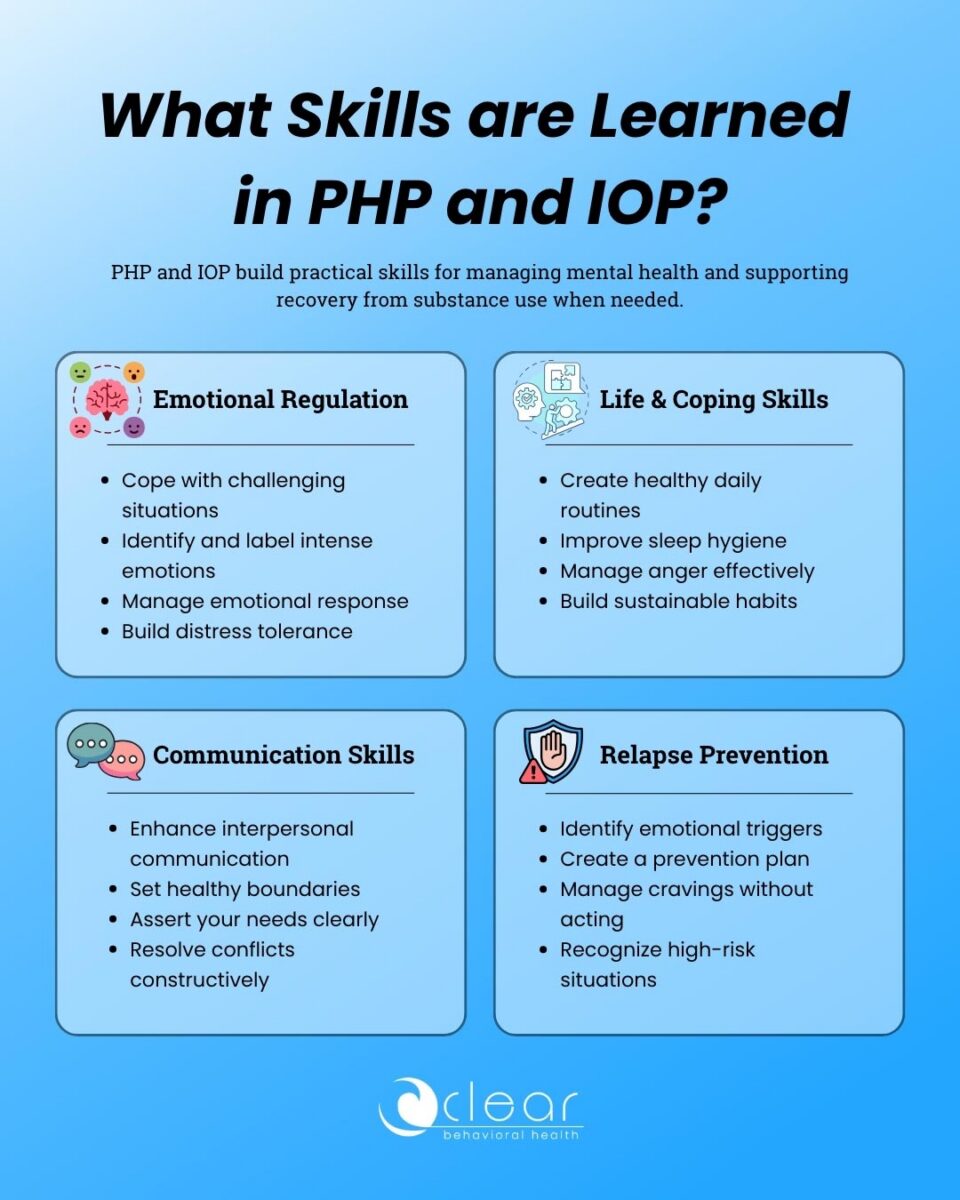
Both PHP and IOP focus on building practical skills to help you manage your mental health and, where applicable, support recovery from a substance use disorder. The skill areas covered in both programs include:
- Emotional regulation – Develop techniques to cope with challenging situations. Learn to identify, label, and manage intense emotions.
- Life and coping skills – Create healthy daily routines, improve your sleep hygiene, and learn how to manage your anger.
- Communication skills – Enhance communication skills and learn how to set healthy boundaries, assert your needs, and resolve conflicts.
- Relapse prevention – Learn to identify emotions or situations that trigger substance use, create a relapse prevention plan, and learn how to manage cravings without acting on them.
The difference lies in how these skills are developed and reinforced. In PHP, there is greater psychiatric oversight, which means skill-building happens within a more structured, clinically supported environment. In IOP, these skills are practiced daily through activities like group therapy and role-playing. Because you have more time in between program days, you have more time to try your new skills out at work, school, or home.
What Is the Main Difference Between PHP and IOP?
While there are many similarities between PHPs and IOPs, the main difference has to do with the intensity of treatment provided.
Intensity and Time Commitment
PHPs require more time commitment each day. They are also more intensive. This makes them a good fit for those needing a higher level of ongoing support.
There’s more flexibility in an IOP. They also require less time per day. This makes them a good option for those transitioning from a higher level of care. They’re also helpful for those who need ongoing support while tending to their daily responsibilities.
Structure and Support
PHPs are highly structured, and they place a strong emphasis on comprehensive medical and psychiatric care. This includes things like medication management, individual and group therapy, and other kinds of therapeutic activities.
IOPs offer a structured environment, too, but with more flexibility. While the types of therapeutic programming are similar, IOPs focus on teaching people the skills they need to successfully manage their mental health condition or substance use disorder.
What To Consider When Making the Choice
There are several things to consider when choosing between an IOP and a PHP. These factors include the severity of your symptoms, how much support you need, and your personal circumstances. Here are a few steps to take to help you make the right decision:
- Talk to a professional – A mental health professional can complete a thorough evaluation of your situation and recommend a suitable treatment option.
- Evaluate your needs – Consider the level of care you need. Do you need intensive support and psychiatric oversight? Maybe you don’t need that level of care, but you could benefit from ongoing therapy that fits into your daily schedule.
- Consider your schedule – What kind of time commitment can you realistically make? Partial hospitalization programs require lots of time each day, while intensive outpatient programs provide you with more flexibility. If time feels like a barrier, a leave of absence may be more accessible than you think.
- Think about support systems – If you have a strong support system at home, an IOP may be more effective. On the other hand, PHPs may be necessary for those needing more structured support.
It’s also important to research the costs associated with each type of program. Reach out to your insurance company to help you understand what type of programs they cover. Financial considerations may influence your decision on which step to take.
Still wondering whether it’s time to take the next step? Not sure which program may be right for you? Experience exceptional care and personalized mental health treatment programs by calling us today.
How Clear Behavioral Health Can Help
Clear Behavioral Health offers a variety of programs designed to help you, no matter what stage of healing you’re at. Through our programs, you can find treatment options that will support you as you focus on your mental health and overall well-being. We also offer addiction treatment programs that provide clients with evidence-based therapeutic modalities in a safe, comfortable environment.
Our compassionate team of mental health professionals uses a mult-pronged approach that includes:
- Group and individual therapy
- Personalized treatment plans
- Whole person healing
- Supportive community
- Continued support & aftercare planning
Whether you are just beginning your mental health journey or transitioning between levels of care, Clear Behavioral Health is here to support you every step of the way. Reaching out is the first step, and you don’t have to figure out the rest on your own.
References
- Chand SP, Kuckel DP, Huecker MR. Cognitive Behavior Therapy. [Updated 2023 May 23]. In: StatPearls [Internet]. Treasure Island (FL): StatPearls Publishing; 2026 Jan-. Available from: https://www.ncbi.nlm.nih.gov/books/NBK470241/
- Chapman AL. Dialectical behavior therapy: current indications and unique elements. Psychiatry (Edgmont). 2006 Sep;3(9):62-8. PMID: 20975829; PMCID: PMC2963469. https://pmc.ncbi.nlm.nih.gov/articles/PMC2963469/
- Schuman-Olivier Z, Trombka M, Lovas DA, Brewer JA, Vago DR, Gawande R, Dunne JP, Lazar SW, Loucks EB, Fulwiler C. Mindfulness and Behavior Change. Harv Rev Psychiatry. 2020 Nov/Dec;28(6):371-394. doi: 10.1097/HRP.0000000000000277. PMID: 33156156; PMCID: PMC7647439. https://pmc.ncbi.nlm.nih.gov/articles/PMC7647439/